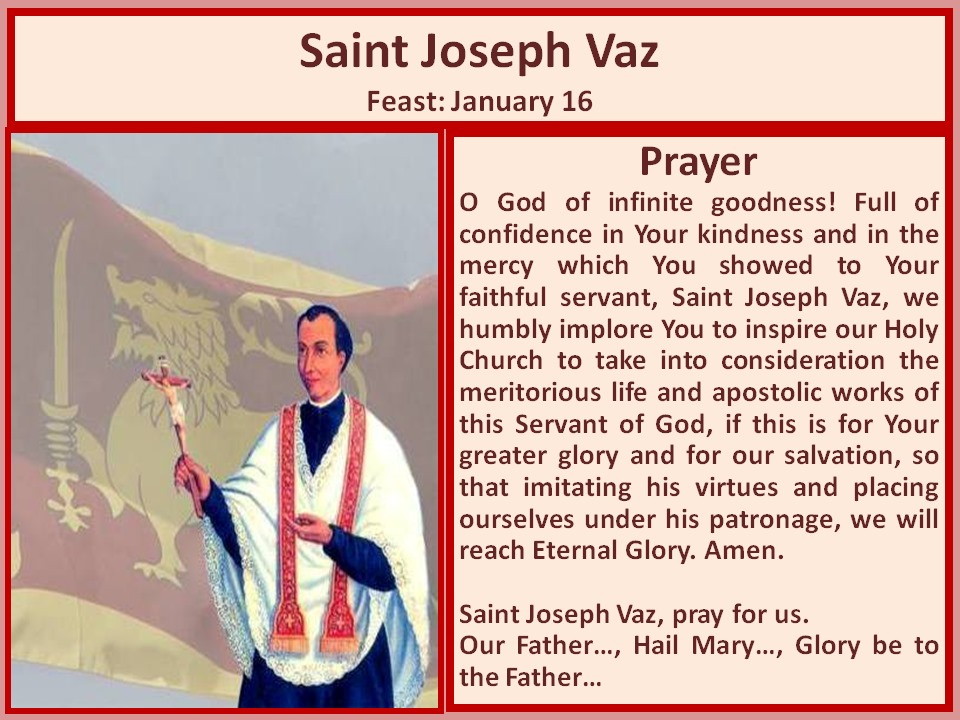
St. Joseph Vaz
January 16th, we celebrate the feast of St. Joseph Vaz C.O, (1651-1711), Indian oratorian priest and missionary, and known as the Apostle of Sri Lanka and was canonized on 14 January 2015 by Pope Francis.
Joseph Vaz was born on 21st April 1651 in Goa, which at that time was the capital of the Portuguese colonies in the Far East, to Christopher Vaz and Maria de Miranda, Christian parents of the Konkani Brahmin caste; the third of six children.
His devout parents brought him up in the faith and he studied humanities with the Jesuits and theology with the Dominicans. His devotion to the Blessed Sacrament saw him praying all night in the local church even as a boy of seven, and it matured into a vocation to the priesthood.
Ordained priest in 1676, he worked for several years in the Kanara region of Southern India. Always devoted to Our Lady, in 1677 he consecrated himself as a “slave of Mary,” sealing it with a document known as his “Letter of Enslavement”.
About this time Joseph learned of the condition of Catholics in Ceylon; persecuted by the Dutch, they had had no priests for 50 years. However, he was assigned the task of preaching in the cathedral and dedicating himself to the service of confession and spiritual direction. The diocesan authorities then sent him to Kanara, in the territory of the Archdiocese of Goa, where the Holy See had erected an Apostolic Vicariate torn by a sad dispute over responsibilities and jurisdictions.
After nearly ten years in Kanara Fr. Vaz returned to Goa and he then felt even stronger the desire to become part of a religious order. However, at that time, religious orders were only open to candidates of European origin. Thus, with the permission of the Archbishop of Goa, he joined three Indian priests who had begun an experience of community life at the Church of the Holy Cross of Miracles on Mount Boa Vista. He was elected superior.
He gave a definitive canonical status to this Oratory, introduced religious exercises and charitable activities, and trained its members for the mission. Driven by the missionary fervor of Fr. Vaz, they soon added to the ministry in their Church an intense apostolate in the countryside.
In 1686 he gave up his position, and set out for Ceylon. Disguised as an itinerant worker, he reached the port of Tuticorin in Easter 1687, and then the Dutch stronghold of Jaffna in the north of Ceylon. He suffered from acute dysentery, contracted from the terrible traveling conditions, and upon recovery he began his mission by contacting Catholics and hiding from the Dutch.
He was taken in by a courageous Catholic, and ministered to his secret flock by night. One step ahead of the authorities, in 1689 he went to the Catholic village of Sillalai and began ministering to folks in surrounding villages.
In 1690 Joseph moved on to Puttalam in the Kingdom of Kandy, where 1,000 Catholics had not seen a priest for half a century. He decided to make Kandy the center of his apostolate, and in 1692 he left for there, hoping to obtain royal permission to travel freely. Instead, he was preceded by Calvinist accusations of being a Portuguese spy, and was imprisoned with two other Catholics.
There he learned Sinhala, the local language, and since the prison guards left the prisoners alone as long as they didn’t try to escape, he built a hut-church and later a proper church dedicated to Our Lady, and began converting other prisoners.
In 1696 the Kingdom of Kandy was suffering a serious drought, and the king asked the Buddhist monks to pray to their gods for rain; there was no rain. He then turned to Joseph who erected an altar and cross in the middle of the square and prayed; abundant rain began to fall, while Joseph and his altar stayed dry. The king granted Joseph license to preach throughout the kingdom.
Making the most of his new-found freedom, he made a mission visit to the Dutch zone and visited Catholics in Colombo. Three missionaries from the Oratory of Goa arrived in 1697 to help him with the news that Don Pedro Pacheco, Bishop of Cochin, had appointed him Vicar General in Ceylon. He was organizing the basic mission structure when smallpox broke out in Kandy. His work with the sick convinced the king to allow Father Joseph every possible freedom in his labors.
Joseph carried his mission to the main centers of the island. He returned to Kandy in 1699 with Father Joseph de Carvalho who had been expelled at the instigation of Buddhist monks. He completed the construction of his new church, and went into service for the king, translating Portuguese books into Sinhala. From this vantage point, he intensified his ministry, and converted some Sinhalese notables, which gave rise to slanders against him and persecution of converts.
New missionaries arrived in 1705, which enabled him to organize the mission into eight districts, each led by a priest. He worked on the creation of a Catholic literature comparable to that of the Buddhists, and to affirm the rights of Catholics with the Dutch Protestant Government.
King Vimaldharna Surya II, Father Joseph’s mentor, died in 1707, but Narendrasimha, his successor, was an even greater supporter. New missionaries arrived in 1708, and in 1710, despite health problems, Joseph took another apostolic trip.
On his return, he fell ill from his carriage, and reached Kandy in serious condition. Though he recovered from a series of infections and fevers over the next year, age, work, and disease had finally worn him out. He undertook nine days of spiritual exercises prescribed by the Rule, but before the seventh day, he was called home to God.
He was beatified in Sri Lanka by Pope John Paul II on 21st June 1995, and was canonized there by Pope Francis on Wednesday 14th January 2015.
St. Joseph Vaz, pray for us
 Story of Saints
Leave a comment