January 17th, we celebrate the feast of St. Anthony of Egypt, the founder of Western monasticism, who laid the foundations of community life, and whose radical approach to discipleship permanently impacted the Church.
Anthony was born around 251, to wealthy parents who owned land in the present-day Fayum region near Cairo. Around the year 270, two great burdens came upon Anthony simultaneously: the deaths of both his parents, and his inheritance of their possessions and property.
These simultaneous occurrences prompted Anthony to reevaluate his entire life in light of the principles of the Gospel– which proposed both the redemptive possibilities of his personal loss, and the spiritual danger of his financial gains.
Attending church one day, he heard – Jesus’ exhortation to another rich young man in the Biblical narrative: “If you wish to be perfect, go, sell your possessions, and give the money to the poor, and you will have treasure in heaven; then come, follow me.” Anthony told his disciples in later years, that it was as though Christ has spoken those words to him directly.
Doing just that, Saint Anthony sold his possessions, distributing them to those in need, and wandered into the deep desert to live and pray. He fasted, eating only a small amount of food after nightfall each day, and spent his days in quiet contemplation and prayer.
Saint Athanasius, who wrote a biography of Saint Anthony, detailed that the Devil was so attracted to this prayerful man, he engaged in an all-out fight with him, afflicting him with boredom, apathy, and temptations of the flesh.
These conflicts took their toll on Anthony in many respects.
When he was around 33 years old, a group of his patrons found him in serious condition, and took him back to local church to recover. This setback did not dissuade Anthony from his goal of seeking God intensely, and he soon redoubled his efforts by moving to a mountain on the east bank of the Nile river.
There, he lived in an abandoned fort, once again subsisting on the charity of those who implored his prayers on their behalf. St. Anthony lived in solitude for about twenty years.
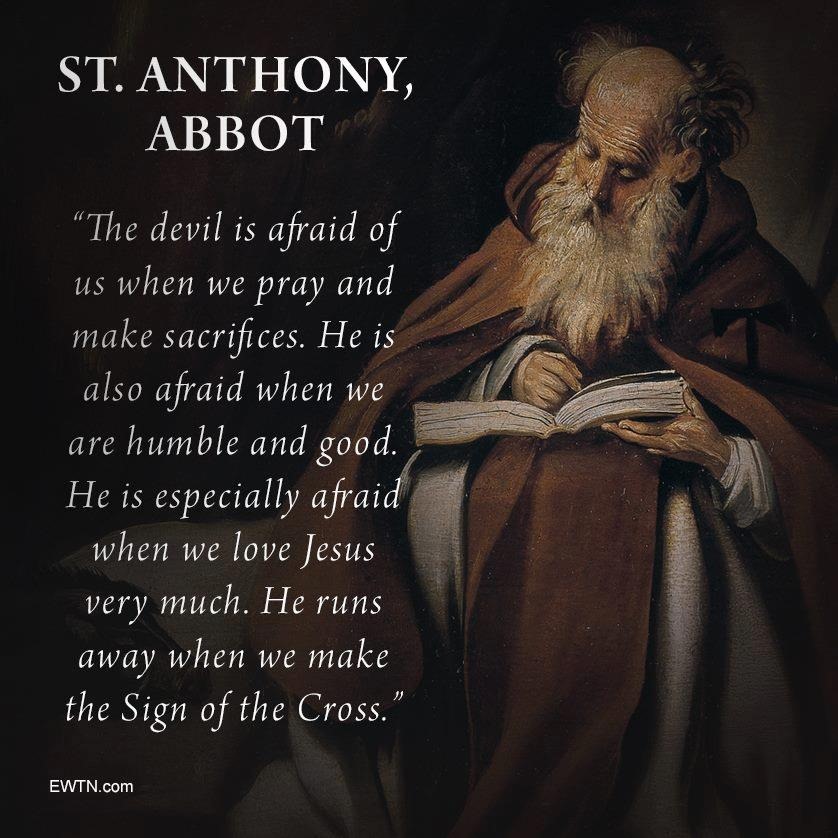
At 54, he responded to many requests and founded a sort of monastery of scattered cells. While he lived separately from the community, he instructed the brothers through manual work and prayer. Many people heard of him and sought his advice. He would give them practical advice such as: “The devil is afraid of us when we pray and make sacrifices. He is also afraid when we are humble and good. He is especially afraid when we love Jesus very much. He runs away when we make the Sign of the Cross.”
Saint Anthony died at the age of 105, and was buried in an unmarked desert grave. This grave was later discovered and moved a number of times to escape destruction and persecution, ending up in France (Saint-Antoine-en-Dauphiné), and held responsible for a number of miracles, including miraculous cures of skin afflictions known as St. Anthony’s Fire.
Anthony is associated in art with a T-shaped cross, a pig and a book. The pig and the cross are symbols of his valiant warfare with the devil—the cross his constant means of power over evil spirits, the pig a symbol of the devil himself.
Prayer:
O God, who brought the Abbot Saint Anthony to serve you by a wondrous way of life in the desert, grant, through his intercession, that, denying ourselves, we may always love you above all things.
Through our Lord Jesus Christ, your Son, who lives and reigns with you in the unity of the Holy Spirit, one God, for ever and ever. Amen
St. Anthony of Egypt, pray for us
 Story of Saints
Leave a comment