Saint Francis de Sales

January 24, we celebrate the feast day of Saint Francis de Sales (1567-1612), bishop of Geneva, Doctor of the Church, the gentleman saint and the patron saint of writers and Christian unity whose role as a priest and bishop helped bring thousands of Protestants back to the Catholic Church.
Born into a noble family in France, and expected to become a lawyer, Saint Francis felt called to the priesthood at a young age. His father wanted him, the first of his six sons, to attend the best schools in preparation for a career as a magistrate. For this reason Francis was sent to Padua to study law. After receiving his doctorate, he returned home and, in due time, told his parents he wished to enter the priesthood.
Tradition holds that despite encouragement from local priests and bishops, as well as teachers, Saint Francis was not convinced that the Lord was calling him to the priesthood until a series of falls while out riding his horse one afternoon. During his ride, Francis was thrown three times from his horse. Each time, his sword fell from its scabbard, landing as a cross.
Upon his third viewing of the cross, Saint Francis returned home to seek parental permission to join the priesthood. His father strongly opposed Francis in this, and only after much patient persuasiveness on the part of the gentle Francis did his father finally consent.
Saint Francis was ordained during the time of the Calvinist Reformation. Just over the mountains from his home in France lay a community of approximately 60,000 Catholics who had renounced the Church, becoming Calvinists. Francis felt moved to venture into the Swiss community and reclaim the converts. Unable to find anyone to accompany him, he embarked alone, on foot, traveling through rough, cold, and snowy country. He visited families in the wilderness, knocking on doors, oftentimes treated poorly.
Despite rejection and years of work without moving a single soul, Saint Francis never gave up. He painstakingly wrote sermons and homilies out by hand, slipping them under doors, becoming one of the first to do so (and becoming the patron saint of journalists in the process).
He slept outside, or in haylofts if possible, oftentimes freezing. His feet, from being constantly cold and wet, became infected and bled. Yet, he did not give up. When parents would refuse to speak with him, he would play instead, with their children. Observing his gentle disposition, patience, and conviction, the parents would often come around and entertain a conversation.
Over the course of several years, Saint Francis’ patience and steadfast determination brought over 40,000 back to the Church. He was appointed Bishop of Geneva. A renowned and holy friendship existed between him and St. Frances de Chantal. In cooperation with her he founded the Visitation Nuns in 1610.
Out of love for his own poor diocese, he refused opportunities for advancement, including the cardinalate. In recognition of the Introduction and his other writings, Francis has been declared a doctor of the Church. As bishop, he tirelessly preached, reaching out to the poor.
He instituted guidelines for clergy, and became one of the first to offer organized catechetical instruction to the young and old alike.
His written works, including “An Introduction to the Devout Life” and “Treatise on the Love of God” are still regarded by the Church as a “bright pointing out to souls an easy and safe way to arrive at the perfection of a Christian life”
In 1622, Saint Francis traveled to France, and while there he suffered a stroke, from which he died at the age of 56. Numerous miracles have been reported by his tomb. Because he is the patron saint of writers, his feast day traditionally marks the release of the Pope’s annual message for World Communications Day.
Frances de Sales was canonized in 1665 and named a Doctor of the Church in 1877.
Prayer
O God, who for the salvation of souls willed that the Bishop Saint Francis de Sales become all things to all, graciously grant that, following his example, we may always display the gentleness of your charity in the service of our neighbor.
Through our Lord Jesus Christ, your Son, who lives and reigns with you in the unity of the Holy Spirit, one God, for ever and ever. Amen
Saint Francis de Sales, pray for us.
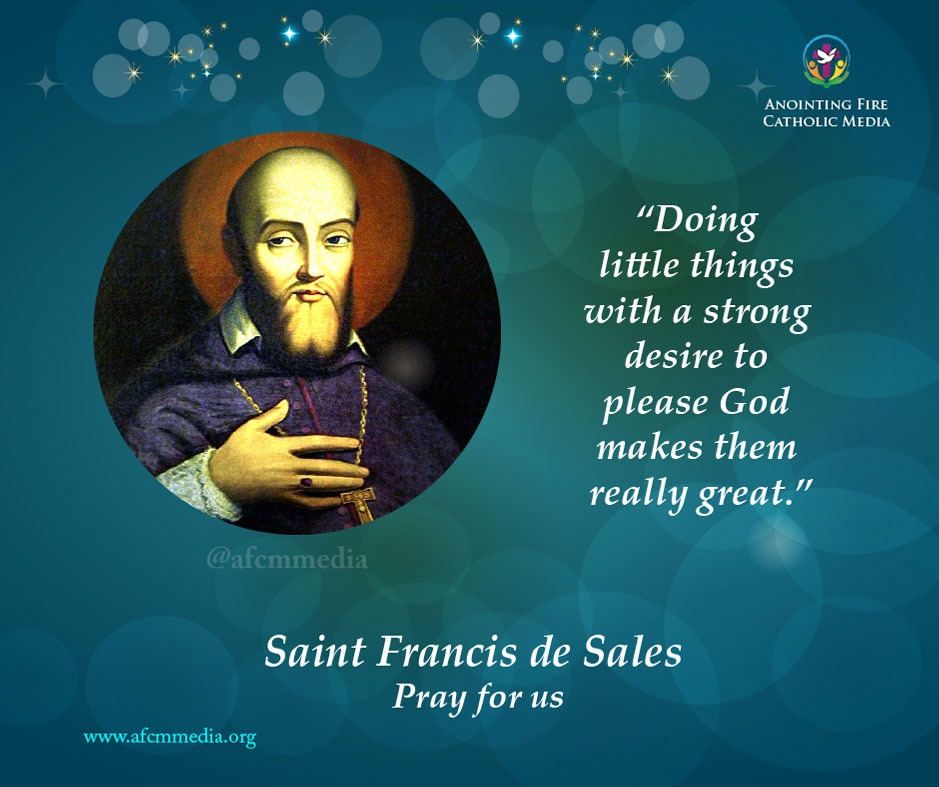
St. Francis de Sales wasn’t afraid to inject some humor into his salty description of false devotion.
His book “An Introduction to the Devout Life” perfectly summarized false devotion. His description of false devotion is delightful and ever timely. Everyone can relate to it, since he salts it with good humor:
“Someone attached to fasting will consider himself devout because he doesn’t eat, even though his heart is filled with bitterness; and while, out of love for sobriety, he will not let a drop of wine, or even water, touch his tongue, he will not scruple to drench it in the blood of his neighbor through gossip and slander.”
“Another will consider himself devout because all day long he mumbles a string of prayers, yet remains heedless of the evil, arrogant and hurtful words that his tongue hurls at his servants and neighbors.”
“Yet another will readily open his purse to give alms to the poor, but cannot wring an ounce of mercy from his heart in order to forgive his enemies.”
“Another still will pardon his enemies, yet never even think of paying his debts; it will take a lawsuit to make him do so. All these, of course, are perennial vices and struggles, and they lead the saint to conclude that “all these fine people, commonly considered devout, most surely are not.”
Not only is this description of false devotion “salty,” but it also cuts a little too close to home.
We may be tempted at times to be proud of our religious devotions, such as fasting or even praying the Rosary, but if our heart is far from God, these devotions are false.
For St. Francis de Sales, the key to authentic devotion is in loving God with our whole heart, mind and strength. We certainly must fast, but if we do, we also need to have a loving heart towards our neighbor.
Our devotional life needs to be matched with an equally intense love of God and neighbor.
Philip Kosloski
Aleteia
 Story of Saints
Leave a comment