Saint Thomas Aquinas
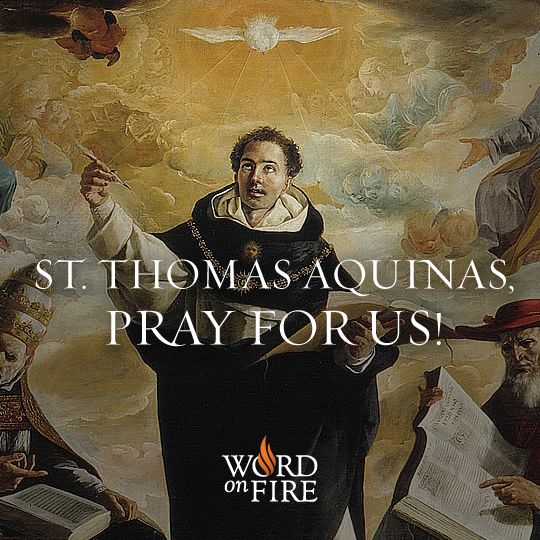
January 28, we celebrate the feast of Saint Thomas Aquinas (1225-1274), the Angelic Doctor of the Church, theologian, philosopher, writer, jurist, patron saint of universities and students, and the greatest intellect and teacher of the medieval Catholic Church.
Also referred to as the Angelic Doctor due to his purity of mind and body and the Universal Doctor, the teachings of Saint Thomas Aquinas greatly influenced not only Church doctrine, but schools of theological and philosophical thought. His most important work, the Summa Theologiae, an explanation and summary of the entire body of Catholic teaching, has been standard for centuries, even to our own day. At the Council of Trent it was consulted after the Bible.
Thomas was born in Aquino, Italy, the son of the Count of Aquino. At the ago of five years old, his father placed him in the care of the monks at the Benedictine Monastery at Monte Casino in his parents’ hopes that he would choose that way of life and eventually became abbot. The boy’s intellectual gifts and serious disposition impressed the monks, who urged his father to place him in a university by the time he was 10. In 1239, he was sent to Naples to complete his studies. It was here that he was first attracted to Aristotle’s philosophy.
Renouncing all his worldly ties and possessions, Thomas entered the Dominican Order in Naples. His family was shocked that Thomas would join a group of poor friars. His mother sent his brothers after him. They kidnapped and imprisoned him for more than a year at a family castle and at one point even sent a woman to seduce him. Nothing would shake his resolution to enter the Dominicans. Once free, he went to Paris and then to Cologne, where he finished his studies with Albert the Great.
Here he was nicknamed the “dumb ox” because of his silent ways and huge size, but his brilliance as a student was evident in his writings. He held two professorships at Paris, lived at the court of Pope Urban IV, directed the Dominican schools at Rome and Viterbo, combated adversaries of the mendicants, as well as the Averroists, and argued with some Franciscans about Aristotelianism. He received his doctorate at the age of 31.
His greatest contribution to the Catholic Church is his writings. The unity, harmony and continuity of faith and reason, of revealed and natural human knowledge, pervades his writings.Prior to his death, Saint Thomas Aquinas undertook to deal with the entirety of Catholic theology. His most acclaimed work, the Summa Theologiae, although incomplete, summarizes the theological underpinnings of our faith in a scientific and rational manner. Saint Thomas ceased writing this work following a supernatural encounter with the Lord while celebrating Mass on December 6, 1273.
During Mass, he is said to have heard the voice of Jesus asking him what he most desired. Thomas is said to have replied, “Only you, Lord,” following which he experienced something which he never revealed. Following that experience, he stopped writing, explaining, “I cannot go on… All I have written seems to me like so much straw compared to what I have seen and what has been revealed to me.”
His love for Jesus in the Blessed Sacrament led him to write prayers and hymns that are still used to honor the Eucharist. He cherished a most tender devotion to St. Agnes, constantly carrying relics of this virgin martyr on his person. He died in 1274, at the age of fifty, in the abbey of Fossa Nuova during a commentary on the Song of Songs.
He is the patron saint of schools and of sacred theology.Pope John XXII canonized him on July 18, 1323. Pope Leo XIII declared him master of all scholastic doctors in 1879 and the universal patron of universities, colleges, and schools in 1880.
In 1965, the Second Vatican Council taught that seminarians should learn “under the guidance of St. Thomas,” in order to “illuminate the mysteries of salvation as completely as possible.”
Saint Thomas Aquinas, pray for us.
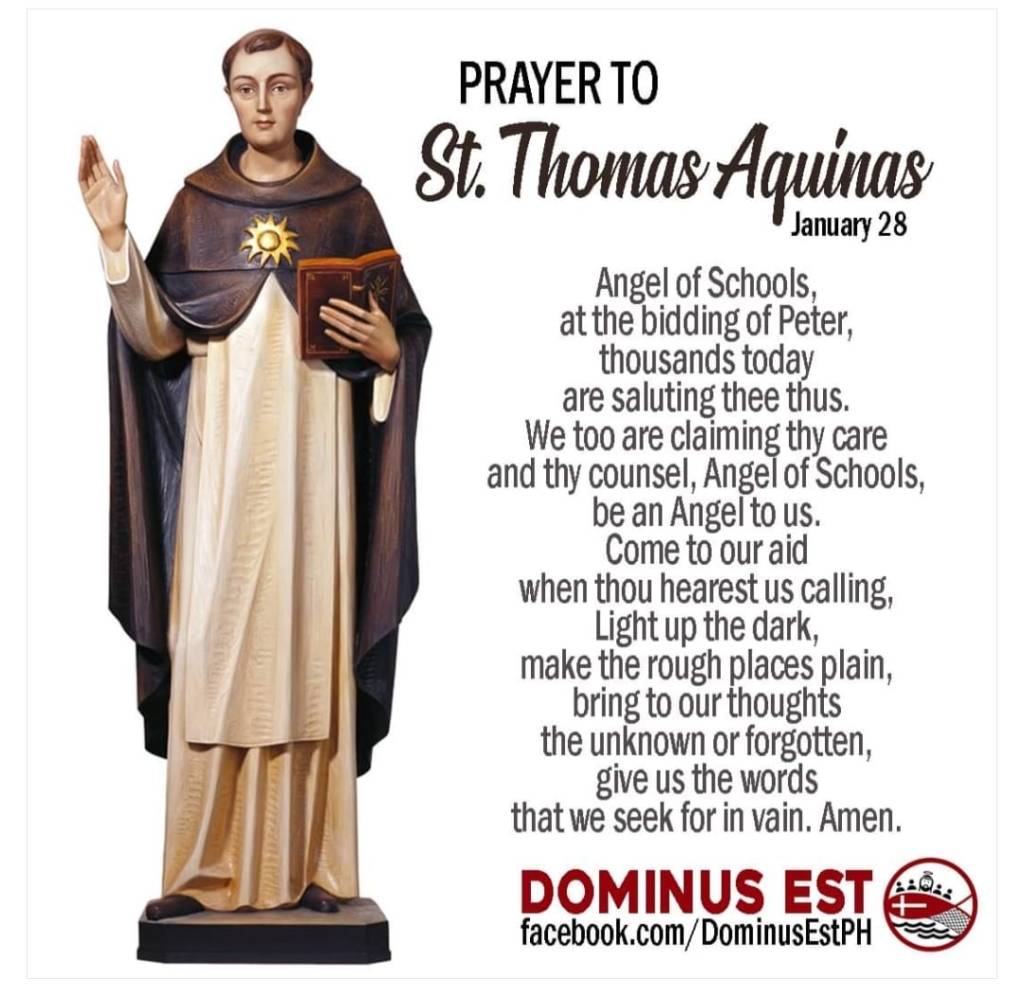
Quotes
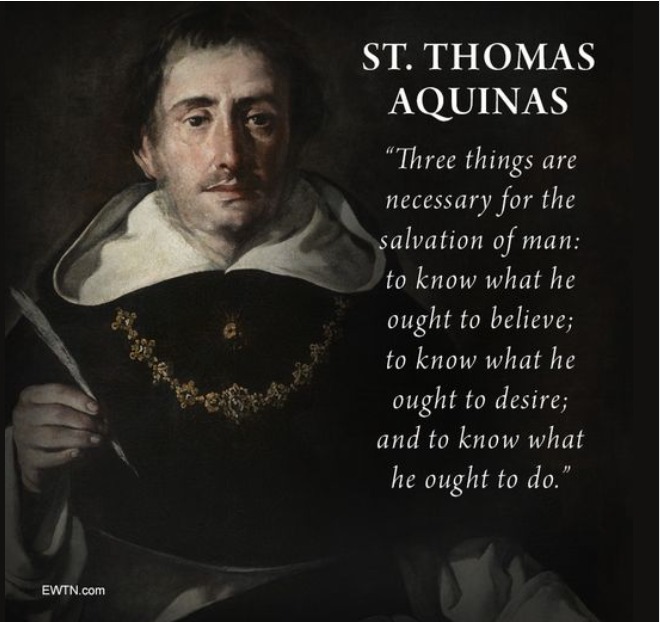
 Story of Saints
Leave a comment