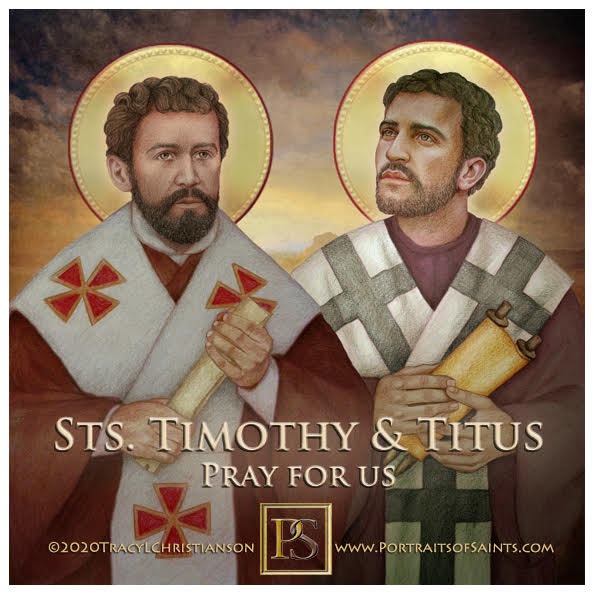
January 26, we celebrate the feast day of Saints Timothy and Titus, early disciples of the Church, close companions of the Apostle Paul and bishops of the Catholic Church in its earliest days.
Saint Timothy ( deceased 97 AD) was born in Lystra, the son of a Greek father and Jewish mother. Being the product of a “mixed” marriage, he was considered illegitimate by the Jews. As a child, he spent considerable time studying the Holy Scriptures, devoting himself to the Holy Spirit.
Upon Saint Paul’s first visit to Lycaonia, Timothy was just a child, but his mother, Eunice and grandmother, Lois, whose faith Paul commends, converted to Christianity. Upon Paul’s second return, approximately seven years later, Timothy, now a young man, followed him, becoming a disciple, confidant, and friend.
Timothy was Paul’s dearest disciple, his most steadfast associate.
Saint Timothy traveled throughout the Mediterranean and Asia (Phrygia, Galatia and Mysia, Troas, Philippi, Veria, Thessaloniki, and Corinth) with Saint Paul, oftentimes the discipline sent ahead to prepare a city, or left behind to guide a new church.
Timothy, known for a gentle disposition, was the discipline whom Paul relied upon to smooth out hard feelings and restore faith in angered Jewish communities, such as Berea (which Paul was expelled from).
Timothy was imprisoned with Paul in Caesarea and then Rome, but later freed while Paul remained. Saint Paul wrote two letters to Timothy, regarding him as his “own son in faith,” one from Macedonia and the second from his Roman prison.
Timothy, regarded as tender and affectionate, lived a life of sacrifice and austerity and he drank only water, likely as penance, and was frequently sick with stomach complaints and ailments. He was made bishop of Ephesus, where he was stoned to death, martyred for opposing the pagan festival of Katagogian in honor of Diana.
Like Saint Timothy, Saint Titus ( death 94 AD) was a close friend of Saint Paul, and accompanied him on many of his missionary works throughout the Mediterranean and Asia (Ephesus, Corinth, Macedonia, Crete, Dalmatia).He was born into a pagan family – is said to have studied Greek philosophy and poetry in his early years.
According to tradition, Titus journeyed to Jerusalem and witnessed the preaching of Christ during the Lord’s ministry on earth. Only later, however – after the conversion of St. Paul and the beginning of his ministry – did Titus receive baptism from the apostle, who called the pagan convert his “true child in our common faith.”
Unlike Saint Timothy, Titus was known as a firm and somewhat fear-inspiring disciple of Paul, sent not to smooth over difficulties, but deliver difficult news and inspire faith and repentance. Saint Titus is viewed as a great administrator of the early Church, responsible for correcting abuses, encouraging alms-giving, and modeling discretion and correction of scandal.
Saint Titus was dispatched by Paul to Corinth (where he was received with “fear and trembling”), to increase the charity of the community, while cementing their faith. This he did with zeal, firmly re-establishing the Church in Corinth prior to Paul’s return. Firm though he was, Titus was also patient, and the first among any group to point out the goodness in others, even when it was hidden.
After the end of Paul’s first imprisonment in Rome, the apostle ordained Titus as the Bishop of Crete.Titus is credited with leading the Church of Crete well into his 90s, overturning paganism and promoting the faith through his prayers and preaching.
Unlike St. Timothy, St. Titus was not martyred, but died peacefully in old age.

Saints Timothy and Titus, pray for us.
 Story of Saints
Leave a comment