Saint Brigid of Ireland

February 1, we celebrate the feast of Saint Brigid of Ireland (453-523), one of three patron saints of Ireland, alongwith Sts. Patrick and Columba, abbess, apostle of charity and founder of several monasteries of nuns, including that of Kildare in Ireland.
Brigid was born out of wedlock, the daughter of a pagan chieftain named Dubthach and a Christian slave woman named Broicsech. The chieftain sold the child’s pregnant mother to a new master, but contracted for Brigid to be returned to him eventually. The child was baptized as an infant and raised as a Catholic by her mother. Thus, she was well-formed in the faith before leaving Broicsech’s slave-quarters, at around age 10, to live with Dubthach and his wife.
From the abundance of her father’s food and possessions, she gave generously to the poor. Dubthach became enraged, threatening to sell Brigid – who was not recognized as a full family member, but worked as a household servant – to the King of Leinster. But the Christian king understood Brigid’s acts of charity and convinced Dubthach to grant his daughter her freedom.
Brigid’s father “freed” her, and she went to live with her mother, who was working as a milkmaid. Brigid continued to give away anything the farm produced—milk, vegetables, grains—to the poor and needy. And while she gave away mass quantities, the stores of the farm only increased, and the owners never went hungry. As the farm prospered, Brigid’s aged mother was freed from slavery.
As Brigid approached marrying age, and became more and more beautiful, her father arranged a number of marriages for her, but she refused each one, stating, “I have chosen the noblest Prince of all… and He is Christ our Lord.” She even disfigured her own face, marring her beauty in order to dissuade suitors. Understanding he could not change her mind, Dubthach granted Brigid permission to pursue her plan, and material means by which to do so.
While consecrated religious life was part of the Irish Church before Brigid’s time, it had not yet developed the systematic character seen in other parts of the Christian world by the fifth century. Brigid and a group of seven virgins founded the first monastic community of Ireland at Cill Dara, modern-day Kildare. The monastery became a “double monastery,” housing both nuns and monks, and Saint Brigid and Bishop Conleth ruled the community as equals, a powerful (and unusual) position for a woman at the time.
She was considered the equal of bishops, many of whom visited her from neighboring areas, seeking her counsel, and sitting at her feet. During her tenure, she built four additional monasteries, over thirty homes for religious orders, and a school of art famous for illuminated manuscripts of Biblical works.Brigid’s life as a nun was rooted in prayer, but it also involved substantial manual labor: cloth making, dairy farming, and raising sheep.
Saint Brigid traveled the countryside, visiting the sick, poor, and needy. She prayed incessantly for them, ministering to their needs, and anointing the dying. On one such occasion, visiting a delirious pagan chieftain, Brigid sat by the man’s bedside, on the ground which was covered with straw. Unable to convince him of the Gospel, given the lack of clarity of his thoughts, Brigid began weaving the straw into a cross. He grew calm, his mind clear, as she explained the message of Christ, His death for us, His resurrection, and our redemption.
The chieftain accepted the word of God, was baptized, and died shortly thereafter. Saint Brigid’s cross became a symbol throughout Ireland for healing and safety in the home. Many homes in Ireland continue to bear the cross on their walls and mantles.
Further extravagant miracles are associated with Saint Brigid. It is said that she provided lavish feasts to visitors to the convent, along with Saint Blath, despite having little food in the larder. She was able to provide a constant supply of milk and ale to her guests. Her shadow was reported to have miraculous healing powers, and she was frequently observed hanging her white cloak (also having healing powers) on a sunbeam to dry.
St. Brigid of Kildare died around 525. She was buried in the same grave with St Patrick and St Columba of Iona . As an abbess, Brigid participated in several Irish councils, and her influence on the policies of the Church in Ireland was considerable.
Veneration of Brigid grew in the centuries after her death, and spread outside of Ireland through the work of the country’s monastic missionaries.
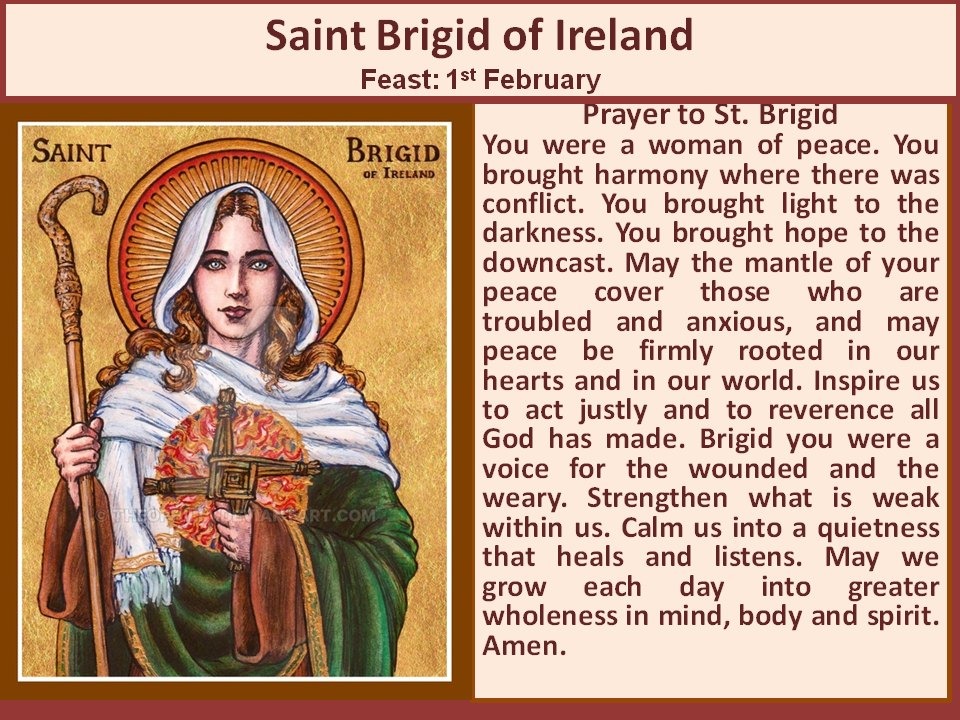
Saint Brigid of Ireland, pray for us.
 Story of Saints
Leave a comment