St. John de Britto
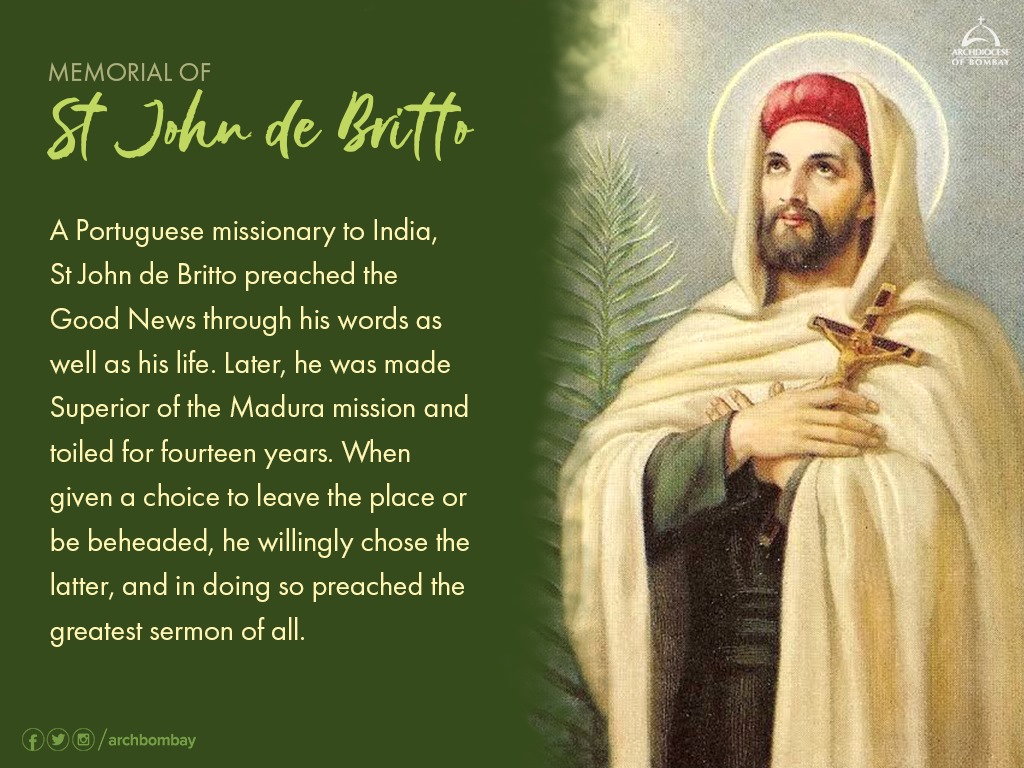
February 4th, we celebrate the feast of St. John de Britto, also known as Arul Anandar (his Indian title and name) (1647 – 1693), Portuguese Jesuit missionary priest and martyr, preacher and often called “the Portuguese St. Francis Xavier” by Indian Catholics and also called the John the Baptist of India.
John de Britto was born into a powerful aristocratic Portuguese family; his father, Salvador de Britto Pereira, died while serving as Viceroy of the Portuguese colony of Brazil. Growing up, John was a playmate to the future King of Portugal, Pedro II. A severe illness made him turn for aid to Saint Francis Xavier, a Saint well loved by the Portuguese; and when he recovered, in answer to his prayers, his mother clothed him for a year in the tunic worn in those days by the Jesuit Fathers. From that time John’s heart burned to follow the example of the Apostle of India.
He joined the Jesuits in 1662, studying at the famous University of Coimbra. Against the strenuous objections of his family, he volunteered for the missions in India in 1673. Blessed John’s mother, when she learned that her son was going to India, used all her influence to prevent him from leaving his own country, and persuaded the Papal Nuncio to intervene, but in vain.
He was sent to Madura and preached the Christian religion in the region of the Maravar country. He labored in the Jesuit province of Madura, which included seven missions, preaching, converting, and baptizing multitudes, at the cost of privations, hardships, and persecutions. As he traveled throughout India on foot, John lived austerely. He dressed himself in the saffron cloak and turban of the native Indians, abstained from eating meat and lived humbly.
Through his holy efforts, John soon became well-known, and developed a group of catechists. At the time Christians belonged mostly to the lower castes. John aimed at converting the higher castes,so that it would be easier to establish Christianity in the region. He and his followers were often subjected to agonizing torture, but each time John miraculously recovered
. In 1683, John was banished from India, and departed for Portugal. Returning soon after, the ardent missionary continued in his apostolate for three more years.
John de Britto’s preaching led to the conversion of Thadiyathevan , a Marava prince who had several wives. When Thadiyathevan was required to dismiss all his wives but one, a serious problem arose.
One of the wives, the niece of the rajah, had John imprisoned and tortured for a month, but being a religious man was no crime, so he was released.
His success in converting Indians to Christianity brought on the ire of the Brahmins, and they decided to kill him. John and his catechists were imprisoned, tortured, and ordered to leave the country. When he refused, the rajah ordered John executed. At the execution site at Oriyur, he knelt in prayer, and the rajah’s order was read.
The executioner hesitated; John told him, “My friend, I have prayed to God. On my part, I have done what I should do. Now do your part.” He was executed on 4 February 1693.
The red sand dune in Oriyur, where there is a shrine now and where the blood of the massacred saint was flown has great significance as the same has got miraculous healing power. Numerous incurable diseases are said to have been cured by the application of the red sand on the respective body parts.
St. John De Britto was canonized by Pope Pius XII on 22 June 1947.
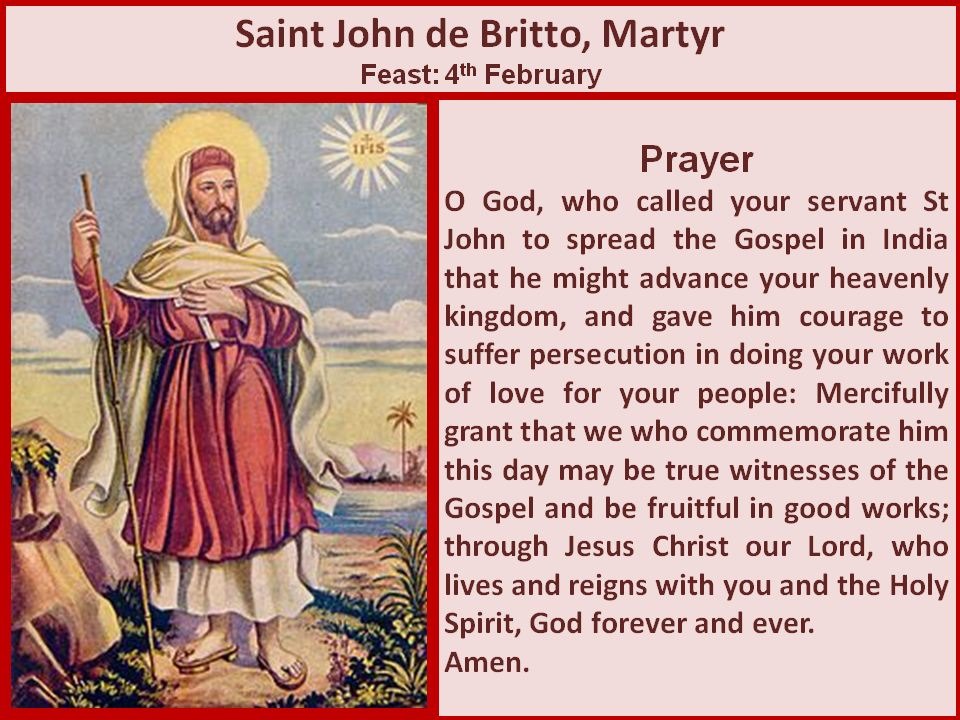
St. John de Britto, pray for us.
 Story of Saints
Leave a comment